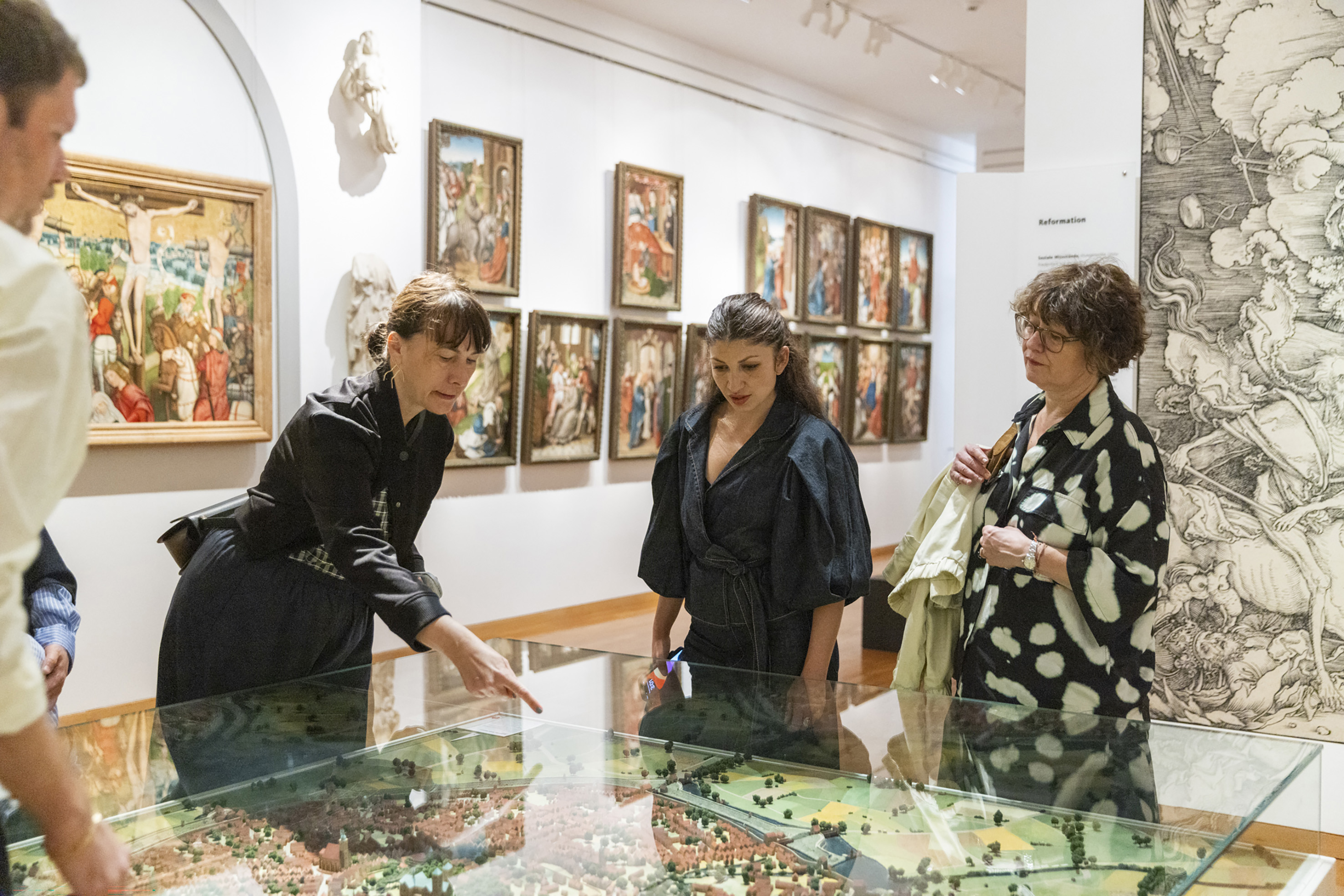
WHW together with Selma Selman and curator Vincent Schier at Stadtmuseum in Münster, photo: Hanna Neander / LWL
Around thirty artists will take part in the upcoming edition of Skulptur Projekte. The first five have just been announced, and further artists will be revealed in the month leading up to the opening on 12 June 2027. Alongside the city centre, Skulptur Projekte will place a particular focus on neighbourhoods in transformation, such as Kinderhaus, Berg Fidel, and the York-Quartier.
The artist Iza Tarasewicz chose Gut Kinderhaus as the setting for her work, which draws on seasonal cycles and agricultural processes. The former farm, now a residential and working community where people with different disabilities live and work, provides the setting for Tarasewicz's intervention, asking: How do people and animals coexist with nature?
In the historical centre, Hew Locke will realise an installation in the Haus der Niederlande at the Krameramtshaus. Built in 1589, the building has been associated with the local merchants’ guild ever since. Locke presents both historical and fictional figures, staged as representatives of power. By working at the historic site of peace treaty negotiations between the Netherlands and Spain leading up to the Peace of Westphalia in 1648, Locke connects the local context to a broader historical one. In doing so, he addresses themes related to colonialism, migration, and the unequal distribution of political power.
Also in the city centre, Selma Selman's installation at the former Hörster Friedhof takes female perspectives and personal histories as its point of departure. Drawing on her own family history, Selman highlights the cycles of globalised labour by using materials that would elsewhere be discarded as scrap, and uses them as tools of collective emancipation.
Róza El-Hassan will be exhibiting her work at the Botanical Garden within Münster's Schlossgarten as well as the district of Berg Fidel in the south of the city. Through personal and collective histories of migration, El-Hassan addresses themes such as displacement and exile as well as vulnerability, fragility, and mutual support.
Further south-east, the York-Quartier, a former military barracks, has undergone one of the most fundamental transformations in Münster’s recent history. Originally built by the National Socialists and used by British armed forces until 2012, part of the site currently accommodates refugees. The entire is in the process of redevelopment into a new residential neighbourhood. In the former Officer’s Casino, Oscar Murillo plans to develop an installation that focuses on shared and communal eating.
Want to find out more? The exhibition venues will be featured on the @skulpturprojekte social media channels over the coming weeks.