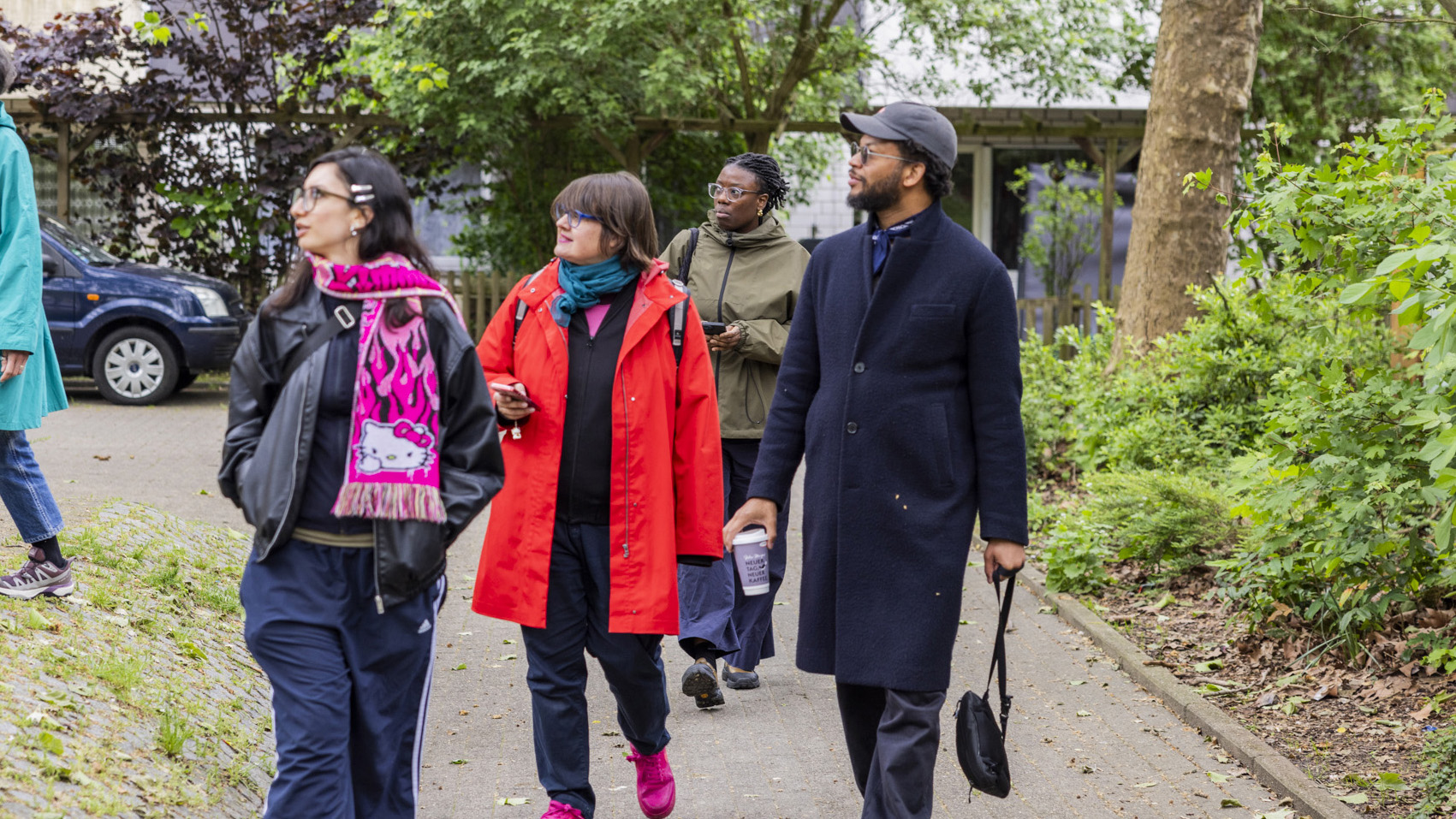
Nolan Oswald Dennis together with the team of Skulptur Projekte Münster 2027, photo: Hanna Neander / LWL
Skulptur Projekte Münster 2027 is taking form!
Following the announcement of the first five artist projects in June (Róza El-Hassan, Hew Locke, Oscar Murillo, Selma Selman, and Iza Tarasewicz), Skulptur Projekte 2027 has now revealed thirteen further artists and artist collectives. Around thirty artistic positions will eventually shape the upcoming edition.
In the spirit of continuity with change, the Artistic Directors What, How & for Whom / WHW, together with curators Vincent Schier and Eva Wilson, build on the unique tradition of Skulptur Projekte as an artists’ project. All artists are invited to develop site-specific works, drawing on Münster’s history and present as well as their own experiences and perspectives. The majority of the sixth edition of Skulptur Projekte will continue to unfold across Münster’s city centre, while also extending into neighbourhoods that have been less present in previous editions.
WHW explain: ‘Informed by the history of Münster as “City of Westphalian Peace”, the artists of Skulptur Projekte 2027 are developing their proposals in awareness of the violence of the present, considering the political decisions, historical global relations, and economic systems that have shaped it. Against the ruptures and losses of recent years, the exhibition asks not only what art can show, but what it can hold. In times when cancellations, censorship, and withdrawal have constrained cultural work, Skulptur Projekte seeks to make room for voices to be heard, for losses to be mourned, for consolation, and for alternatives to be proposed. An artwork in the public space need not compete for visibility in an already overly saturated world; it can offer time to witness, to feel, and to stay with what cannot readily be resolved. At a moment when political and economic propositions struggle to make a positive future imaginable, the faint hope of Skulptur Projekte 2027 is that such encounters with art in public space might allow for perspectives to be felt and acknowledged that are often misrepresented or obscured, without forcing consensus where none exists.’
Knowledge, Language, and Collective Creation
Mercedes Azpilicueta is developing an imagined landscape that invokes shared experiences and invites playfulness, while drawing attention to the neighbourhood’s plant life. Working with with residents in the neighbourhood of Berg Fidel as well as collaborators from the fields of botany, poetry, performance, and architectural design, she asks how stories and interactions between humans, plants, and other forms of life can open up possibilities for imagining new worlds.
Also in Berg Fidel, in the south of Münster, Nolan Oswald Dennis is mapping the neighbourhood onto the cosmos and vice versa, constructing an astronomical observatory that also serves as a calendar. Dennis’ artistic practice examines how access to public knowledge can be reimagined, while exploring a Black consciousness of space.
Questions of how language shapes public discourse inform the project developed by Alice Creischer and Andreas Siekmann. Their work often refers to specific historical events, recontextualizing them within new poetic narratives that address questions of power, politics, and economy. For Münster, Creischer and Siekmann have chosen seven parliamentary debates held at the German Bundestag between 2019 and 2025 as their material. Andreas Siekmann returns to Münster after having participated in the fourth edition of Skulptur Projekte in 2007.
Between the Urban and the Rural
Myvillages is an artist collective whose co-founders, Wapke Feenstra and Kathrin Böhm, are exploring rural life in Münster and the surrounding Münsterland. Their work focuses on the rural as a place of diverse knowledge, co-produced culture, and different forms of economy. They make visible the interdependent histories and relationships connecting the urban and the rural. By bringing together people from different fields and generations to (un)learn together, Myvillages challenge the idea that cultural life is centred in cities.
Kosen Ohtsubo began studying ikebana, a traditional Japanese art form that uses plants as its material, in the 1960s. Since then, he has developed his own forms of expression beyond conventional ideas of beauty. His large-scale installations often incorporate materials drawn from everyday life, such as vegetables, worn clothing, and discarded objects. In Münster, he has chosen to work with apple trees from the region that are cut down when they no longer bear fruit. Together with a local team, he will use these trees to create a large outdoor installation in the city centre.
Kapwani Kiwanga explores structures of power and how history shapes our present. For Münster, she is developing a project that uses a form of timekeeping to make the vast timescales of Earth’s history tangible. At its centre is water: it nourishes life, erodes surfaces, serves to measure time in water clocks, and can be abused as a weapon of war. The latter has a specific relevance for the city: in 1660, Münster’s Prince-Bishop obstructed the river Aa to flood the city, breaking its resistance during a historic siege.
Which Stories Are Remembered?
Near a busy crossroads at the threshold to the historic city centre, Iman Issa plays with established forms of public commemoration. Working with the idea of ruins and their afterlives, she explores how objects can be interpreted differently when placed in new contexts. In doing so, she questions who decides what is displayed in public space.
Natascha Sadr Haghighian is creating a space for mourning and commemoration. The project continues her artistic practice of tracing biographies and individual life stories to reveal the social conditions that shape them. Drawing on the experiences and structures of migrant communities in Germany, her work addresses the violence of racism, dispossession, displacement, and exclusion.
Ashfika Rahman turns to invisibilized labour in her project for Münster. Influenced by her childhood experience of travelling through Bangladesh with her mother, a social worker, Rahman often collects testimonies from marginalized voices. Using poetry, drawing, and forgotten languages, she weaves these experiences into intricate installations addressing questions of social justice, human rights, land rights, and women's rights.
Traces of War, Violence, and Displacement
For Skulptur Projekte 2027, Vlatka Horvat is researching a peace monument erected in Münster in 1905 that was subsequently melted down in service of the Second World War industry in 1942. Her work, developed in response to this history, takes the form of sky observatories: sculptural forms that create a sensory encounter with the surrounding landscape and the sky above. At the same time, they raise the question of how looking into the sky might differ in times of peace and war.
Anton Kats explores interconnected histories and contemporary forms of fascism, taking the ongoing war in Ukraine as a starting point. For Münster, he brings political and territorial systems of ordering into relation with systems of sound-tuning and instrument design. He is developing an interactive sculpture for Kinderhaus in Münster’s north that functions as a collective instrument, inviting people to question and rethink established structures.
Khalil Rabah's artistic practice critically interrogates questions of identity and belonging. His project for Münster highlights tensions between mobility and containment, cultivation and extraction, and rootedness and displacement. In times of uncertainty, his work explores how belonging is continually shaped and negotiated rather than remaining something fixed.
In the garden of the former Officers' Casino in the York-Quartier in Gremmendorf in the south of Münster, Ali Cherri presents new large-scale sculptural works. Built during the Nazi era, the building later served as a social club for British armed forces. Cherri's dreamlike scenarios address the lives of soldiers, juxtaposing the physical consequences of military discipline with tiredness, exhaustion, and sleep as subtle expressions of vulnerability and resistance.
Neighbourhood Partners
Local relationships and networks play an important role for Skulptur Projekte Münster 2027. The curatorial team and the mediation team around Barbara Kiolbassa are working with three Neighbourhood Partners: Gabriela Exner, Natividad Abaga Ayecaba, and Luzy Ludwig. With strong ties to Kinderhaus, Berg Fidel, and Gremmendorf, they bring local perspectives into the development of the exhibition and advise the teams and artists on questions of participation, inclusion, and meaningful community engagement.
Looking Ahead to 2027
The full list of artists and projects will be announced on 17 March 2027. Guided tours will also be available to book from that date.
A public opening celebration will take place on 12 June 2027. From 13 to 20 June, an extensive programme of events will invite visitors to participate and explore. The exhibition will run from 13 June to 3 October 2027.